Guides
Image Inpainting: From Pixel Propagation to Controllable Generation
Image inpainting fills missing or selected regions while keeping the result consistent with the visible image. Its capabilities have expanded through four approaches: extending nearby pixels, borrowing existing textures, learning image semantics, and generating content according to user intent. These approaches continue to coexist because they address different problems. This guide covers the representative research from 1999 to 2025 — the main approaches, the problems they solve, and how to evaluate them.
中文版:图像修复的完整脉络(中文)。
1. What does image inpainting repair?
This page focuses on image completion with a known mask. Inputs typically include an image I, a mask M, and optional text, structural guidance, or reference images. Here M=1 means the region to fill and M=0 means the region to preserve. If pixels outside the mask must remain unchanged, the original image and prediction Î can be composited in pixel space:
I_out = (1 − M) ⊙ I + M ⊙ Î
This describes output compositing; it does not mean every model's raw output preserves known pixels. A feathered mask creates a blending band, so the permitted area of change must be defined explicitly.
| Term | Main problem | Relationship to inpainting |
|---|---|---|
| Region completion | Fill specified missing areas | The central task here |
| Object removal | Reconstruct the background after removing an object | One completion intent |
| Generative fill | Generate or replace content using instructions | An intersection of completion and editing |
| Outpainting | Extend content beyond the original canvas | Completion outside the original image boundary |
| Denoising, deblurring, super-resolution | Recover images affected by degradation | Broader image restoration tasks with different capability requirements |
Completion often has multiple valid answers. A model may produce a natural-looking face without recovering the original face. Evaluation should distinguish similarity to ground truth, visual plausibility, and compliance with the intended edit.
2. How the approaches connect
The diagram below maps how ideas and problems relate. Arrows do not establish direct inheritance between every paper, and newer approaches do not simply replace older ones.
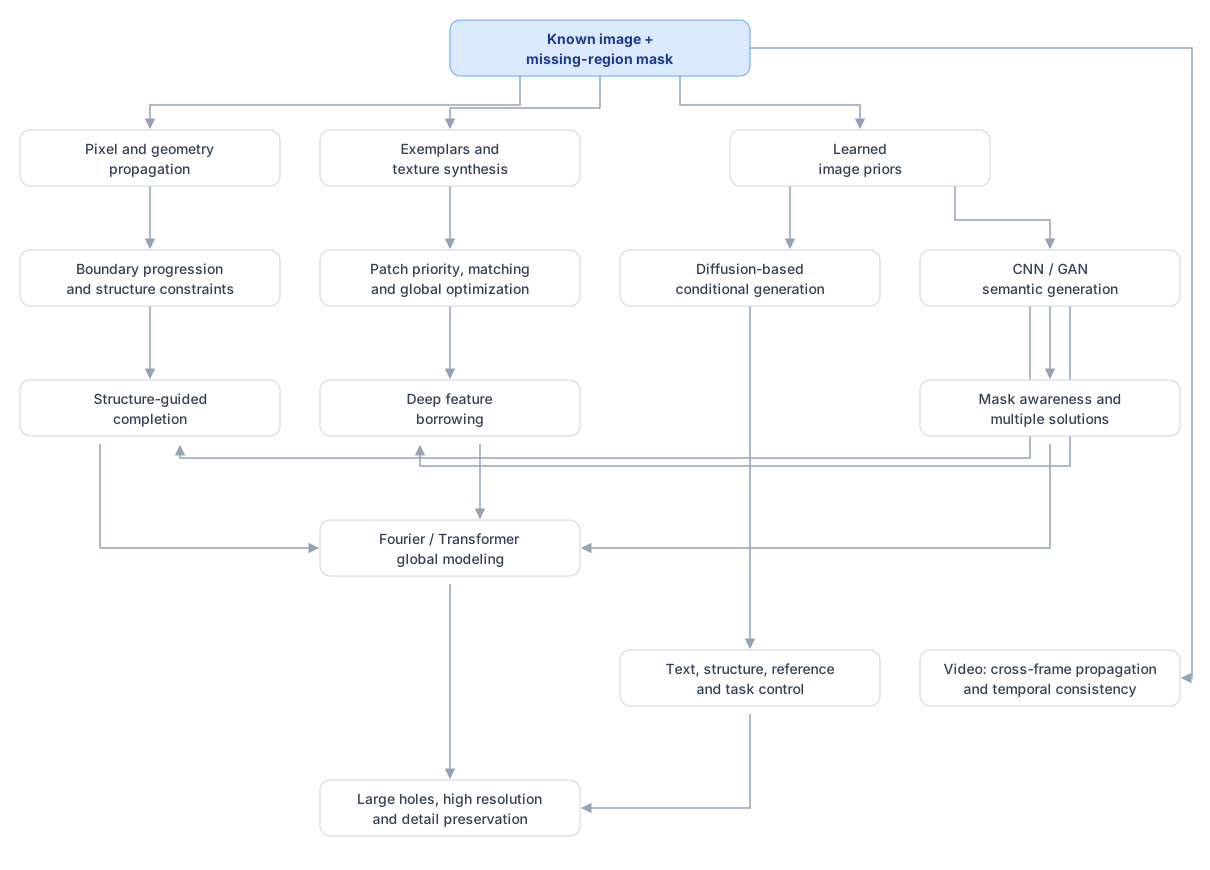
For any method, ask six questions: What gets filled first? Where does content come from? How are candidates selected? What maintains global structure? Can there be multiple answers? How does the user control the result?
3. 1999–2004: Pixel continuation and texture synthesis
Early research addressed two different needs: scratches require nearby colors and contours to continue, while larger missing areas require suitable texture material.
Structure propagation emphasizes contour and isophote continuity. Bertalmío and colleagues' 2000 work applied this idea to digital inpainting. Telea's 2004 method used fast marching to estimate pixels progressively from the boundary inward. These methods establish the foundations of small-region repair, but local propagation cannot infer arbitrary missing semantic content. Bertalmío 2000, Telea 2004
Texture synthesis seeks reusable material. Efros and Leung (1999) sampled pixels using similar neighborhoods. Image Quilting (2001) assembled patches and handled their overlap seams. Both contributed the idea of searching and combining existing texture. Non-parametric texture synthesis, Image Quilting
The shared limitation is that usable local color and texture do not establish the correct scene semantics. Also distinguish early PDE information diffusion from modern generative diffusion: the latter samples content through a learned denoising process.
4. 2003–2015: Exemplar patches combine structure and texture
Criminisi and colleagues' 2003/2004 work combined fill order with patch copying: identify the hole boundary, prioritize boundary patches, find a similar patch in the known region, copy its pixels into the unknown area, and update the mask and confidence. Criminisi 2003, Criminisi 2004
The classic priority is P(p) = C(p) · D(p). Confidence C describes the amount of reliable information, while the data term D emphasizes structure entering the hole. This framework addresses both fill order and the source of filling material.
Incorrect matches can propagate, similar colors can hide incorrect structure, and missing source material limits semantic recovery. Later work tackled these issues separately.
| Problem | Representative work | Main idea |
|---|---|---|
| Continue important lines first | Structure Propagation, 2005 | Complete user-specified curves before filling the remaining texture |
| Local matches conflict | Global Optimization, 2006 | Jointly optimize candidates and neighboring patch consistency |
| Searching the image is expensive | PatchMatch, 2009 | Approximate nearest-neighbor search with random search and propagation; generalized in 2010 |
| Representation fails to distinguish structure and texture | Patch Sparsity, 2010 | Use structural sparsity and sparse patch representation |
| Repeated structures need broader regularity | Patch Offsets, 2012 | Use dominant displacement statistics to combine shifted candidates |
PatchMatch is primarily a matching algorithm. A complete inpainting system also needs reconstruction, mask handling, and consistency constraints.
5. 2016–2019: Learning to generate missing semantics
When the source image contains no usable eye, window, or animal contour, completion needs information beyond that image. Deep learning supplies priors learned from training examples.
Context Encoders (2016) predicted missing content with an encoder–decoder and reconstruction and adversarial objectives. Globally and Locally Consistent Image Completion (2017) used two discriminators to assess overall coherence and local realism. Context Encoders, Global and local consistency
Contextual Attention (2018) explicitly borrowed deep features from visible regions. This connects learned generation with exemplar matching in feature space. Contextual Attention
The capability expanded from copying available material to combining visible evidence with learned priors. Outputs consequently depend on the training distribution and may look natural while changing the original object's shape.
6. 2018–2020: Masks, structure, detail, and multiple answers
Standard convolution processes valid pixels alongside placeholder values inside holes. This creates a need to distinguish trustworthy information.
| Branch | Representative method | Capability added |
|---|---|---|
| Explicit validity rules | Partial Convolution, 2018 | Convolve valid inputs, renormalize, and update the mask |
| Learned information selection | Gated Convolution / DeepFill v2, 2019 | Learn gates for spatial positions and feature channels; the first preprint appeared in 2018 |
| Structure first | EdgeConnect, 2019 | Predict edges and condition image generation on them |
| Multiscale borrowing | PEN-Net, 2019 | Transfer contextual attention across a feature pyramid |
| Multiple plausible answers | Pluralistic Image Completion, 2019 | Generate different plausible completions for the same context |
These branches address input validity, shape, detail, and uncertainty. They can be combined rather than treated as mutually exclusive categories.
7. 2021–2023: Global context, large holes, and high resolution
Attractive texture can coexist with misaligned windows and broken lines. Local features alone may not adequately constrain the entire scene.
| Method | Global modeling mechanism | Main concern |
|---|---|---|
| LaMa, 2021 preprint / WACV 2022 | Fast Fourier convolutions, a high-receptive-field perceptual loss, and large training masks | Large holes, periodic structures, and generalization beyond training resolution |
| MAT, CVPR 2022 | Mask-aware Transformers combined with convolutions | Long-range context for large-hole completion |
| ZITS, CVPR 2022 | Transformer-based structure prediction followed by guided generation | Global structure and texture consistency |
| PUT, CVPR 2022 | Patch tokens and unquantized input features | Information loss from downsampling and quantization in pluralistic completion |
Older concerns such as structure-first reconstruction and borrowing visible material persist through new representations. High resolution also requires more than a large output file: check internal resizing, retained detail, long-range consistency, and seams. Of these convolutional networks, LaMa has become the default open model — and the strongest one that fits a browser: try it in our LaMa inpainting tool.
8. 2022–2025: Diffusion expands completion into controlled editing
Generative diffusion produces content through iterative denoising. Inpainting requires the sampling procedure or network to use known image regions, masks, and other conditions.
RePaint (2022) constrained sampling from a pretrained unconditional diffusion model and used resampling to improve compatibility with known content. Latent Diffusion Models (2021 preprint / CVPR 2022) moved diffusion into a compressed latent space to reduce computation and support conditional generation, including inpainting. RePaint, LDM
Later work focused on expressing intent, injecting conditions, and reducing cost.
| Method | Representative date | Focus |
|---|---|---|
| PowerPaint | 2023 preprint / ECCV 2024 | Task prompts distinguish background completion and object generation, with shape control and outpainting |
| BrushNet | ECCV 2024 | Separate masked-image features from noisy latents and inject conditions into pretrained diffusion networks |
| TurboFill | CVPR 2025 | Train an inpainting adapter on a few-step generator to reduce sampling cost |
Removing a person calls for background completion; adding a chair calls for a specified object. Identical masks can therefore represent different tasks. Evaluation must consider contextual consistency, instruction adherence, and known-region preservation. Diffusion's practical value depends on the task, latency, control, detail requirements, and cost of failure.
9. Video inpainting: more evidence and temporal constraints
A background hidden in one frame may be visible in another. Video completion should exploit that evidence before generating areas without available observations.
The field progressed from spatiotemporal patch matching to optical-flow propagation, cross-frame attention, and combinations of propagation and Transformers. ProPainter (ICCV 2023) combines flow completion, pixel and feature propagation, and a mask-guided sparse Transformer. ProPainter
Natural-looking individual frames can still flicker or drift during playback. Evaluation must also cover flow errors, changing occlusions, scene cuts, and long-term temporal consistency.
10. Choose an approach by the task
| Task | Approaches to evaluate first | Failures to inspect |
|---|---|---|
| Scratches and small defects | Pixel propagation, fast marching | Smoothing and broken edges |
| Object removal with reusable background | Exemplar patches, fast matching, learned completion | Incorrect copying, texture repetition, orientation errors |
| Large holes or semantic gaps | Global-context networks and generative models | Wrong shapes and training-distribution bias |
| Text-directed insertion or replacement | Controlled diffusion inpainting | Instruction mismatch and changes outside the mask |
| High-resolution photographs | Global understanding with detail preservation or local refinement | Artificial enlarged detail, seams, inconsistent tiles |
| Video removal | Cross-frame propagation and video completion | Flicker, flow errors, temporal drift |
A practical workflow aligns image orientation and mask dimensions, confirms mask polarity, selects the intended edit, runs completion, preserves or blends known pixels, inspects boundaries and structure, and exports the result. Missing shadows or reflections in the mask can leave visible traces even when the algorithm runs correctly.
11. Evaluate the hole, known region, and boundary separately
Whole-image averages can hide errors because unchanged pixels dominate the result.
| Dimension | Possible assessment | Interpretation limit |
|---|---|---|
| Reconstruction similarity | PSNR and SSIM | Require ground truth; plausible alternative answers may differ from it |
| Perceptual difference | LPIPS and human comparison | Do not establish semantic correctness or edit compliance alone |
| Sample distribution | FID | Describes a collection of outputs, not correctness of one image |
| Structural coherence | Lines, perspective, contours, repeated patterns | Requires relevant scene-specific cases |
| Known-region preservation | Pixel differences outside the mask | Define feathering and permitted changes |
| Boundary blending | Color, texture, and gradient continuity in a boundary band | Whole-image scores may conceal local seams |
| Diversity and control | Repeated samples and condition adherence | Diversity must coexist with plausibility |
| Engineering efficiency | Latency, memory, resolution, success rate | Standardize hardware, inputs, warm-up, and sampling |
| Video consistency | Temporal errors and playback inspection | Single-frame realism does not establish temporal coherence |
A useful experiment fixes images, mask shapes and areas, resolution, and model settings; includes small holes, long lines, repeated structures, faces, and large objects; records regional metrics and visual outputs; retains failures; and documents seeds, sample counts, and candidate-selection rules for stochastic methods. These dimensions form a synthesized evaluation framework — they should not collapse into an unexplained quality score. RePaint also discusses the limits of comparing diverse outputs with one ground-truth image.
12. A reading path — and where this site fits
Read by the problem being solved:
- Pixel continuation: Bertalmío and Telea.
- Sources of texture: Efros and Leung, Image Quilting, and Criminisi.
- Reliable search and composition: structure propagation, global optimization, PatchMatch, Patch Sparsity, and Patch Offsets.
- Missing source material: Context Encoders and global/local consistency.
- Visible feature reuse: Contextual Attention, Partial/Gated Convolution, and PEN-Net.
- Shape and uncertainty: EdgeConnect and Pluralistic Image Completion.
- Global relationships and information loss: LaMa, MAT, ZITS, and PUT.
- Intent and generation cost: RePaint, LDM, PowerPaint, BrushNet, and TurboFill.
- Cross-frame evidence: video completion and ProPainter.
The closest branch to the algorithm this site runs is the exemplar chain: Criminisi → candidate representation and scoring → search efficiency and global consistency → deep feature borrowing. Our implementation is the 2016 feature-priority refinement of Criminisi's method — a classical, non-generative technique that only borrows real pixels from your image, which is why it runs privately in your browser. Where this branch ends — semantic gaps with nothing to borrow from — is exactly where the learned and diffusion approaches above take over.
The field's development connects three requirements: use visible evidence effectively, introduce plausible priors where evidence is missing, and align completion with user intent. Modern models extend these capabilities while classical methods remain useful foundations for understanding structure, texture, matching, and error propagation.
Try patch-based inpainting in your browser
The tool below runs the exemplar branch of this history — Criminisi's framework with the 2016 feature-priority fix — entirely on your device. No upload, no signup, no watermark.